Sunday, July 28, 2013

Keeping It Cool

Published in the Sun 7-27-2013
Dahlia Lopez and her weatherized house

People used to live in Texas without air conditioning, but I wasn’t one of them.  My parents didn’t have air conditioning until the month before I was born, during the heat wave of 1954, when my father took pity on my pregnant mother and bought a window unit for the living room.  They put my crib in the cool room, so I became one of the first members of the AC generation.


We all know that in a hot, muggy climate like central Texas air conditioning is hands down the biggest electricity hog in our homes.  In the summer, air conditioning can account for 70 percent of the electric bill.  But knowing a fact about electricity, and being willing to live without air conditioning are two entirely separate things.  Just typing that sentence made me so hot I had to turn the thermostat down.  So what is an ecologically-minded person to do?


Most people, when they think about saving money on air conditioning, imagine turning up the thermostat and suffering.  There is certainly nothing wrong with adjusting the thermostat, and I highly recommend it, but what if you could be just as cool as you want and still use half the electricity?  Wouldn’t that be a no-brainer?


Does this scene ever happen at your house?  The kids are going in and out the kitchen door, leaving it wide open behind them.  Finally a practical person, usually the one who pays the electric bills, interrupts the fun by yelling, “Shut the door!  We can’t air condition the entire outdoors.”  The kids of course are thinking that it would be a really good idea to air condition the whole outdoors because, hey, it’s super hot out there.


But the truth is that, without being aware of it, many people are trying to cool the whole outdoors all the time, even when the door is closed.


Dahlia Lopez had that problem.  She lived in an old farm house that belonged to her grandparents back when people just resigned themselves to the ambient temperature.  Houses back then were not designed to keep cold air inside.  They were designed to let a breeze blow through, and that is exactly what Dahlia’s house did.  In the winter an arctic wind blowing through the bathroom turned an ordinary shower into an ordeal.  In the summer the house never felt cool and her utility bills were topping $300 a month, even though her house is not very big.  Not only was she hot in the summer and cold in the winter, but she was wasting money that she had better ways to spend.


Dahlia had recently retired and didn’t have the disposable income needed to remodel and weatherize her home, but she qualified for a city program that helped owners of older homes reduce their energy requirements.  An energy auditor did a blower door test, in which a big fan sucks air out of the house, allowing the auditor to find all the places where outside air is leaking in.  The test proved that Dahlia’s vintage house was no barrier to the elements, with air leaks around her windows and doors, through the attic, and even around her electrical outlets.  The auditor made recommendations, and then a contractor came in and blew fiberglass insulation into her attic and walls, insulated her outlets, sealed and replaced windows, and caulked and weather-stripped her doors.  She got new fiberglass batts and drywall in her bathroom, and solar screens on her windows.  This work was done in the winter and Dahlia noticed a difference right away.  She could go to bed without bundling up like an Eskimo.


The financial benefit hit home in the summer.  Prior to the weatherization work her June electricity consumption was 1600 kilowatt-hours.  This past June she used only 666 kilowatt-hours, a savings of about $100 on electricity in just one month.


If you live in an old drafty home, you certainly need an energy audit.  If your home is fairly modern but the electric bill seems too high in the summer, or if your air conditioner seems to be running all the time and you are still not comfortable, or if your attic is hot enough to bake bread, you may also have room for improvement.  An insulation company can make recommendations, which is fine if you already know that you need insulation, but if you are not quite sure what you need, an independent energy auditor can evaluate your house and find out exactly where you are wasting energy and save you hundreds of dollars a year on electricity.  Go to RESNET, Residential Energy Services Network, to find an auditor who is not selling anything but advice.


I know insulating your house is not very sexy, but it’s the most important energy conservation move you can make, reducing your carbon footprint and saving money at the same time.  Letting your conditioned air disappear into the atmosphere is like icing down your beer and leaving the ice chest open.  It’s just not cool.

Sunday, July 21, 2013

Local Women Ride Train to Austin and Return Unscathed

Published in the Sun July 20, 2013

Metrorail train at the Leander Station

There has been a lot of spirited conversation recently about passenger trains, and whether or not Georgetown needs a passenger train to take us to Austin and San Antonio.  Frankly, most of the conversing has been by people like me who have their own personal automobiles waiting to deliver them door-to-door wherever they want to go, at the exact moment they are ready to depart, and haven’t boarded a bus or a train since their last vacation in London or Vancouver, unless you count the tram at the Dallas airport.


Williamson County already has a new passenger train, of course:  the Capital MetroRail running from Leander to the Austin Convention Center.  I had read a few things about the MetroRail, but I hadn’t met anyone who had actually ridden it.  There is no teacher like experience, so I set aside a day to explore, and my friend Sherry Dana agreed to come along and keep me company.


We arrived at the Leander Park and Ride (or Kiss and Ride as it’s called if you get dropped off) about 30 minutes early for the 8:40 AM train, the last morning train to depart from Leander.  The morning rush was over, and the parking lot was mostly full.  The station is beautifully landscaped with stone walks and native plants.  We couldn’t find any public restrooms though, so don’t drink too much coffee before you go.  We bought day passes from a machine for $5.50 each that would allow us to get on and off the train all day, and ride connecting Capital Metro buses as well.


While we waited for the train, I asked a young man if he was a regular train-rider.  Taking his earbuds out (pretty much everybody under 30 on the train was connected to earbuds), he told me that he likes to take the train to his software job everyday because he can do his extra computer work with the train’s WiFi while he rides.  Or he can sleep.  The trip all the way downtown takes 55 minutes, about the same time it would take to drive and park.  The train, however, never has to worry about traffic.


At 8:40 we got on the train, which was spotlessly clean and cool.  The northern part of the route is scenic through the countryside.  Whenever we came to a crossroad the barriers came down and we barreled on through.  This is nothing like driving on IH 35.  The train made several brief stops and 5 to 20 people would get on or off.  Most of the people were going to work, but at one station a group of three young mothers and five children boarded, headed for an adventure at the Austin Children’s Museum.


Sherry and I got off at Plaza Saltillo, at the corner of 5th and Comal in East Austin.  Hidden behind the station in a nondescript warehouse was Texas Coffee Traders, where they import and roast coffee, and will also brew a cup for a thirsty traveler.  But Sherry and I were looking for breakfast, so we walked one block to 6th Street and found ourselves at Cisco’s.  To me it looked dubious, but Sherry assured me Cisco’s was famous, and that all the Texas legislators used to eat there, and we did indeed have some excellent egg tacos and coffee.  The lawmakers were unfortunately otherwise engaged.


After breakfast we finished our southbound train ride to the Convention Center and walked around downtown.  It turns out 6th street is not that much fun at 11:30 in the morning, especially when the temperature gets up into the 90s, so we decided to take our public transit adventure to the next level – a connecting bus.  All the train stops are coordinated with a connecting Capital Metro bus, so we hopped back on the train and headed north to the Martin Luther King Station.  Waiting for us was the bus taking passengers to campus.  Here again, Sherry was the smart one.  Somehow she knew that Thursday is free day at the Blanton Art Museum.  I love the upstairs part of the Blanton but the downstairs can be strange.  The most bizarre exhibit was a large piece of corrugated cardboard leaning against the wall.  I know some people look at modern art and say, “I could do that,” but really, I could lean a piece of cardboard against the wall, and in fact I have, many times, and never got put in an art museum.


Catching the right bus back to the train station was the only tricky part of the whole journey, because by now of course it is 102 degrees and Capital Metro maps are written in Egyptian hieroglyphics crisscrossed with nanoscopic color-coded lines.  But every bus stop has a number on it and you can send a text to the bus company and immediately get back a text that tells you when the next bus is coming, so you can sit very still at the bus stop under a tree and not sweat too much.  After a ten minute wait we were back on a cool bus and the driver took us straight to the train station.


Back in Leander, MetroRail operator Narvin Logans let me look in the cockpit and blow the horn.  He explained that the operators really do drive the trains; they are not computerized or on autopilot. He also said that the afternoon trains coming back north are usually standing room only.  Sometimes the train is a few minutes late to Leander because so many people unload at Lakeline.


By the way, don’t try to ride the train without buying a ticket.  Tickets are mostly by the honor system, but every once in a while the fare-checker comes by, and he brings a policeman with him.  A young man got caught on our return trip, and the policeman wrote him up.  The fine could be anywhere from $100 to $400.  We got off the train with the perpetrator and asked him if he was a regular rider.  He assured us that he always pays the fare, except just this one time, because he almost missed the train.  That’s his story, and I’m just going to believe it, because he seemed like such a nice guy.

People exiting the train at Leander

Sunday, July 14, 2013

Horny Toad Redux

Published in the Sun July 13, 2013

Ouida Henderson with a picture of her mother and the horny toad wagon

After writing about the decline in central Texas of “Horny Toads,” properly known as Texas Horned Lizards, I received the following letter from Nancy McMillan Higgs, who, as a child, lived around the corner from me in Austin.  Here is her story in her own words.


“Clearly you had moved away from Exposition Boulevard before you started learning about horny toads because I certainly would have taught you that they ate red ants.  I think, however, that I did not begin to learn about them till I was maybe 7, when we – Mom, Dad, and me – drove to Denver from Austin to visit one of my dad’s best friends.  We always started these trips in the wee hours of the night so we stopped in Lampasas for breakfast.  As we left the café, I spied a rather large horny toad by the car and Dad caught it for me.  I dutifully named him “Lampasas.”  He not only travelled all the way to Denver with us, but also to the top of Mount Evans, where I “hypnotized” him while sitting at the counter of the mountaintop café, sipping Alka Seltzer for my motion sickness.  I can still remember the mesmerized truckers sitting across from me and Mom…they had never seen a horny toad before!  During the trip, my mom was in the midst of making a Christmas stocking, so she made Lampasas a nice, sequined, elastic collar and leash that I used to tie him up next to ant beds for lunch while we ate.  Lampasas rode all the way home with me and was released in our backyard.  I’m not sure I ever saw him again, but at least a couple of weeks of his life were quite colorful.”


Nancy, who is quite the horny toad aficionado, continues with another story.  “I particularly loved the baby toads – maybe the size of a silver dollar.  One time I had one at home and was playing with it when my aunt was visiting.  I’d hypnotized it.  She didn’t see the before part, just the lie still on its back part.  She asked to hold it so I gave it to her.  She was admiring how it looked so real (duh) when I replied that it was indeed real.  And – you guessed it – she screamed and threw her hand up, the innocent little horny toad flying up into the air and striking the ceiling before coming down hard on the floor.  Dead on impact.  I was honestly appalled and disgusted at her ignorance and hysteria.  Luckily, she was my favorite aunt so eventually I got over it.”


Obviously, being a pet was quite hazardous duty for a horny toad, and in fact human attention is one of the major factors in their decline.  During the 1950s and 60s, many Texas children earned pocket money by catching live horny toads and mailing them to pet stores and curio shops in other states.  Nancy’s grandfather, a Jarrell farmer, paid her 25 cents each to catch horny toads, but he released them into his vegetable garden to eat insects, so likely Nancy’s lizards survived the transaction.


Ouida Henderson, an 85 year old Georgetown resident, related that ever since she was a child, her mother, Irene Moore Waddell (born 1899), had kept a small metal wagon, with attached horse, displayed in their home.  A bit of tan colored string, six or eight inches long, is tied around the horse’s neck and has remained tied there for all these many decades.  The loose end of the string was used by Irene and her little brother to harness a horny toad to the wagon, pulling both wagon and horse around the sandy streets of Hempstead, west of Houston.  Ouida is sure that it was their favorite toy, and she has kept the wagon displayed in her own home since her mother passed away.  I asked if Ouida herself used horny toad labor to pull the wagon, but she denies it.  “I wasn’t one to catch them.  I wasn’t a brave soul.”

Saturday, July 6, 2013

Rustling Up Some Grubs at the Austin Bug-Eating Festival

Published in the Sun July 6, 2013

Alan Davisson sautés up some insects

“Does anyone want to eat the baby cockroach that was inside that other cockroach?”  It’s 107 degrees in Zilker Park, but Alan Davisson has his fryng pans hot and is sautéing insects at the 6th Annual Bug-Eating Festival.  I can’t even get close enough to see the baby cockroach, much less eat it, because of the crowd of curious bug-eaters.  Alan goes on to explain to the kids in the group, “All of my heroes are weird.  They all changed the world because they did something weird.”  We can all pretty much agree that Alan is weird.


He redeems himself somewhat and admits that he doesn’t like to eat cockroaches, because they just taste like cockroaches.  The best insects to eat, according to Alan, are grubs and larvae, because they don’t have shells and legs.  They are however filled with dirt, so to properly prepare a grub you have to cut off the head, slit it up the side and wash it in water to remove all the brown stuff.  When cooked up, the fat solidifies and the grub is more meaty, like bacon.  Yumm.


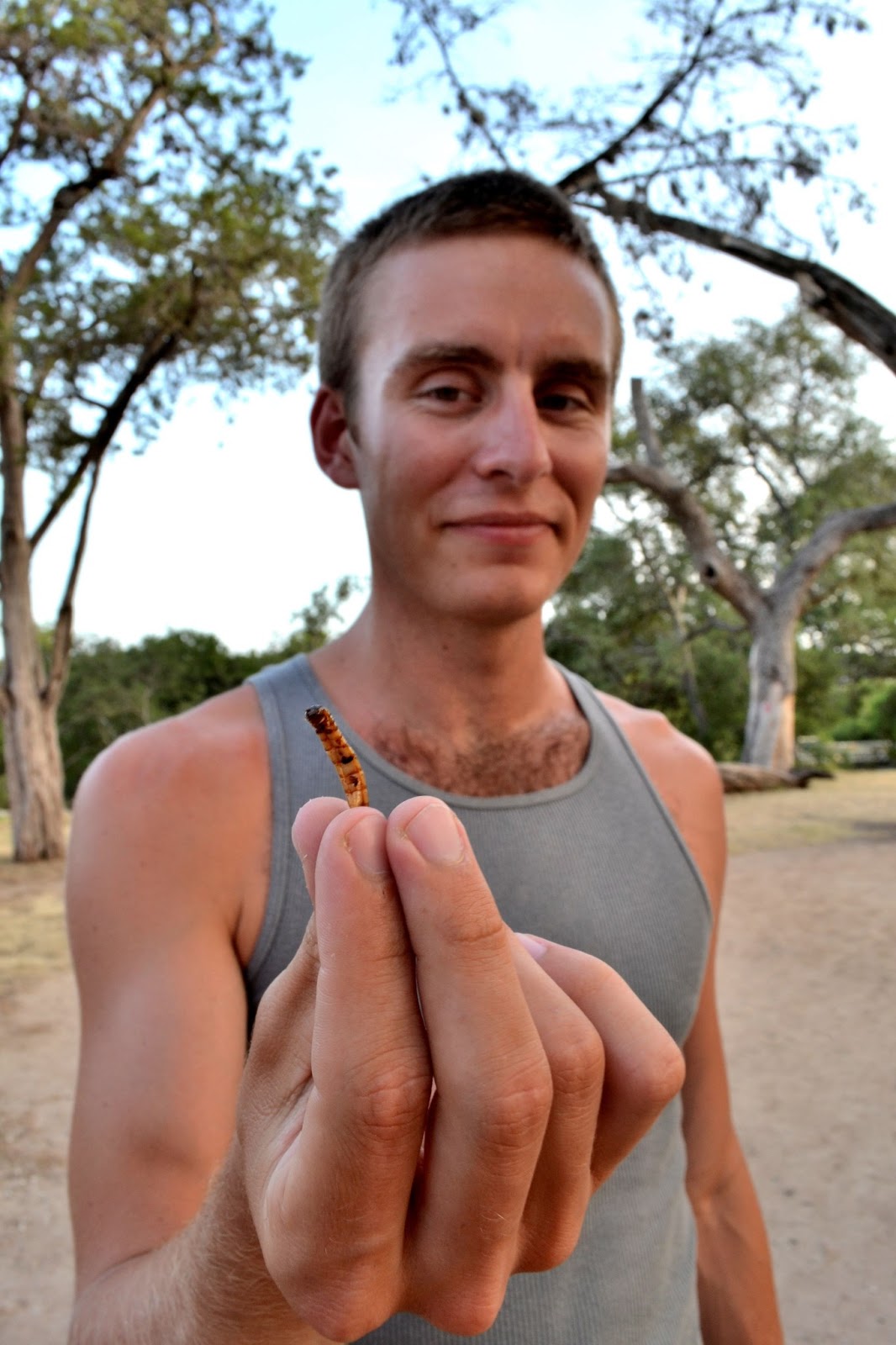
A table behind the throng of Alan’s on-lookers holds the mealworms he cooked up before moving on to cockroaches.  Some are Cajun-flavored and some are plain.  A sign on the table warns people with shellfish allergies not to eat them, as shellfish and insects contain similar allergens.  A man standing beside me apologizes that he has a shellfish allergy and won’t be able to partake.  “Sure you do,” I snark back.  His friend elbows him, “Dude, she knows you’re lying,” and we all laugh.  But I have come here to eat bugs so I might as well get on with it.  Grabbing one of the bigger mealworms I take a tentative bite.  It’s kind of crunchy with a non-descript flavor, so I pretend it’s a chow mein noodle and finish it off.  I use the same technique with a wasp larva.  Really, they are so small that a tiny bite is much ado about nothing, once you get past the yuck factor.

 
Jeffrey Stump contemplates a mealworm


Marjory Wildcraft, who put this bug-eating event together, checks to see if I’m having a good time.  Marjory has been called the “Martha Stewart of Self-Reliance.”  Her business is teaching people to grow their own food in backyard gardens.  I asked her how she got interested in bug-eating.  She explains that there are certain fats and minerals that are hard to get if a person is really trying to grow all their nourishment.  She noticed in her own garden that insects were a constant, and annoying, presence, and thought, “Why don’t I try eating bugs?”  Just one little problem, “They are disgusting.”  So she got a few friends together for moral support, and after three beers to lubricate the system, she was ready to eat bugs.  That was the first Bug-Eating Festival, and it multiplied from there.


A discerning reader at this point would be asking, “Why on earth are we talking about eating insects?  What’s the point of this insanity?”


Entomophagy, which is Greek for “eating insects”, has always been common in traditional societies.  Beetles and caterpillars are the most popular food bugs, but over 1900 species have been used for food.  Some people think that entomophagy may spread to developed cultures as populations continue to increase.  A recent United Nations report reminds us that by 2050 there will be 9 billion people on earth.  There are only 7 billion of us right now, but already one billion are chronically hungry.  Turning more forests into farmland for pigs and cattle is problematic, and ocean fisheries are already in serious decline.  Insects are a sustainable source of protein, and they can be farmed efficiently using less land and less water than mammals, and are frequently fed with biowaste.


Continuing my tour around the festival, I tried a chocolate chip cookie made with mealworm flour, which was fairly tasty, although with enough chocolate almost anything is edible.  Getting braver, I tried an ant lion that Alan had just served up.  It was way too crunchy and got stuck in my teeth.  Seriously I had to rinse my mouth out when I got back to the truck and spit it out.  Mealworms and wasp larvae might be okay in an emergency, but avoid ant lions.  We really need to take better care of those ocean fisheries.
 
Sunny Greenblum, age 7, eats a chocolate covered mealworm
 

Saturday, June 29, 2013

Homebuilding Outside the Big Orange Box

Published in the Sun June 29, 2013

Jason Ballard demonstrates a Nest self-programming thermostat

“Smart Building, Better Living,” is the motto of the Treehouse store on South Lamar.  I arrived without an appointment to see Jason Ballard, the force of nature behind this unique home improvement center.  I don’t know what Jason looks like, but this huge store seems like an ambitious business venture, so I inquire of the most distinguished looking man on the floor.  He is not Jason, but goes to look for him.  When he comes back he tells me that Jason is in a meeting but will be with me shortly and invites me to look around.


Wandering past the bulk chicken feed and the home canning supplies, I find myself in flooring.  A big sign lists the pros and cons of various kinds of flooring materials.  Carpet can be made of recycled materials, but harbors dust and allergens.  The wood floors sold here are certified by the Forest Stewardship Council.  Cork is more comfortable on your feet than hardwood and uses waste from the wine industry, so no trees have to be cut down.


The paint department sells wood finishes and paints which are free of volatile organic compounds.  A kitchen design center displays custom countertops made from recycled glass, concrete, sustainable Mexican teak, or even a recycled paper product that feels like any other solid surface countertop.  And this is the really amazing thing, actual salesmen are available to help you plan your new kitchen or bathroom and make sure it’s built and installed correctly.


While I am lusting after countertops, the distinguished looking man tells me that Jason is available, and points to a fresh-faced, skinny lad wearing a blue t-shirt.  What?  That kid looks more like the leader of a church youth group than the president of a multi-million dollar corporation.  Actually Jason is 31 years old and married with children.  He admits, however, that ministry was one of his possible career paths.


Jason grew up hunting and fishing with his grandfather, who taught him respect for the natural world.  They never killed anything they weren’t planning to eat.  After studying ecology at Texas A & M, Jason worked for a while in Colorado with a sustainable building company.  He learned that most buildings are tremendously inefficient and waste vast amounts of energy, but consumers are in the dark about how to improve the situation.   He also realized that no home improvement store would promise its customers, “We will not sell you something that is poison.”  A consumer who wants safe, environmentally responsible products is on his own.  Jason saw a niche in the business world that needed to be filled.


So Jason Ballard, ecologist, decided to go head to head with Home Depot and Lowe’s and create an oasis of non-toxic, sustainable, and energy efficient products.  There was just one tiny little problem:  he knew nothing about running a business.  Well, almost nothing.  He knew that if you take care of people and sell them good things, they will be loyal customers.


He assembled a team of experts to create his brainchild:  lawyers, marketers, merchandisers.  Jason concentrated on vetting his potential products, spending hours on the phone and internet researching ingredients and environmental implications.  Treehouse doesn’t sell anything that Jason hasn’t scrutinized.


I asked Jason to show me something he is really excited about.  Without hesitation he led me to a display of Nest Learning Thermostats.  Everybody knows that programming the thermostat saves electricity, but normal people just never get around to it.  The Nest Thermostat, invented by the same guy who invented the iPod, learns your personal habits and programs itself.  Jason is emphatic, “People always want to put solar panels on the roof.  This $250 thermostat will save more energy than a $10,000 solar system.  Solar panels should be the last thing you do when you are trying to save energy, not the first.”  When the Nest first came onto the market, the makers wanted to sell exclusively to the big box chains.  Every Tuesday for months, Jason called them, begging for the right to carry the Nest, until they finally said, “OK, OK, you can sell it.  Stop calling us.”


Jason used the same hounding technique to get the Switch LED light bulbs.  “This is the Aston Martin of light bulbs,” he brags, “and Treehouse is the first place in the world to sell it.”  The store is phasing out compact fluorescent bulbs, because LEDs save more energy, and don’t contain mercury.


We continue around the store, Jason enthusiastically pointing out a plant-based alternative to WD-40, insulation made from recycled blue jean denim, tankless water heaters.  I ask when he will be expanding into Williamson County.  He admits he would like to open a branch in Round Rock, as soon as he can swing it financially.


On the Treehouse website, Jason has written “Dreams matter:  We believe we all have a say in what tomorrow looks like, so let’s make it even better.”  Hooray for young people like Jason, thinking outside the box.


Wednesday, June 26, 2013

The Horns of a Carbon Dilemma

Published in the Sun June 22, 2013


I read recently that one can be environmentally friendly to the extreme in recycling and energy savings, but that a single short commercial jet flight wipes out anything green you have done over an entire year.  It’s all owing to the fact that jet engines are terribly inefficient and it takes a humongous amount of fossil fuel to keep the plane and its passengers aloft. 

George Flynn, Georgetown
 

George has impaled himself on the horns of a dilemma.  In modern times, we have the luxury of doing things that were completely impossible before the age of fossil fuels.  A few hundred years ago, the only sources of useful power were human muscle, animal muscle, and fire.  The Founding Fathers had large numbers of servants, both voluntary and involuntary, for the express purpose of doing hard physical labor, such as plowing fields and chopping wood.  Today, most of us can’t afford a retinue of servants to do our work for us.  Instead we use fossil fuels, in the form of gasoline or coal-generated electricity.  We have “energy slaves” to cook our food, wash our clothes, light our houses, and push our cars around town.  If you assume that a human worker can sustain a work output of about 80 watts, the average American has 147 “energy slaves” working around the clock to maintain his regal lifestyle, cooling our offices and harvesting our food while we post cat pictures on Facebook.


A Boeing 747 uses about 80 megawatts of power to take off, the equivalent of one million “energy slaves” pedaling like crazy.  You just can’t do that without jet fuel.


On a round trip flight from New York to San Francisco, the combustion of that jet fuel produces 2 to 3 tons of carbon dioxide emissions per passenger.  Since most of us (in the States) generate about 19 tons of carbon dioxide every year, air travel is a significant part of our carbon footprint.  You would be absolutely correct to point out that Al Gore, jetting around the world to discuss climate change, has a much bigger carbon footprint than some unfortunate soul who doesn’t really care about carbon emissions but can’t afford to go anywhere.


So here is the dilemma:  We love to fly.  Who doesn’t adore a vacation in the Caribbean?  We also are hooked on air conditioning, the biggest electricity hog in our Texas homes.  Are we to give up flying and cooling for the sake of being “green”?  There are some who say that if the earth becomes uninhabitable for human beings our grandchildren will wish we had taken this question a bit more seriously, and they have a valid point.  On the other hand, if I personally give up jet travel and air conditioning, staying home to sweat miserably this summer, all my sacrifice accomplishes in the short term is to take the pressure off ERCOT, allowing some less virtuous person to crank his thermostat down to 68 degrees and have friends over to see his pictures from Aruba.


I can’t single-handedly save the planet, but that doesn’t mean I’m off the hook.  I can make a multitude of “green” decisions that actually improve my overall well-being.  Using energy efficient light bulbs saves money on my electric bill.  Eating less meat reduces my carbon footprint and is healthier for my heart.  Locally grown foods are delicious.  A small car is easy to park.  Bicycling tones my bum.  Recycling is completely painless.  Take a train somewhere, or vote to build a train somewhere.


The famous architect and inventor Buckminster Fuller said this about the power of the individual:  “Something hit me very hard once, thinking about what one little man could do.  Think of the Queen Mary – the whole ship goes by and then comes the rudder.  And there’s a tiny thing at the edge of the rudder called a trimtab.  It’s a miniature rudder.  Just moving the little trimtab builds a low pressure that pulls the rudder around.  Takes almost no effort at all.  So I said that the little individual can be a trimtab.  Society thinks it’s going right by you, that it’s left you altogether.  But if you’re doing dynamic things mentally the fact is that you can just put your foot out like that and the whole big ship of state is going to go.”

 
The words “Call Me Trimtab” are engraved on Fuller’s headstone

Sunday, June 16, 2013

Save the Texas "Horny Toad"

Published in the Sun June 15, 2013
Original art by David Stump

When threatened by a predator, the Texas Horned Lizard, widely known as the “Horny Toad,” holds perfectly still in the mistaken belief that its camouflage will protect it.  That strategy might hide it from a hawk, but to a human child a motionless horny toad is all too visible and easy prey.


Most Texas baby boomers, and many generations before us, have fond memories of catching and playing with horny toads.  Deprived of video games, our mothers would send us out into the yard, where we were forced to seek entertainment from the landscape.  Both in town and in the country, horny toads were everywhere, providing hours of diversion.  Genie Vogler remembers tying a string around the little horns on their heads and leading them around on a leash.  Dean Hamilton made his captives pull tiny wagons made out of matchboxes.  Another friend, who wishes to remain anonymous because he is otherwise a kindly soul who deeply regrets his misspent youth, used to blow them up with firecrackers.


I lived on a busy street in Austin, but there were plenty of horny toads around our house, and I frequently kept one in a shoebox.  I probably tried to feed it Velveeta cheese (a personal favorite snack) and of course it wouldn’t eat, so after a few days I would let it go.  I didn’t know that the horny toads in my yard were feasting on the red harvester ants that had a permanent bed on the far side of the driveway.  We never tried to get rid of the ants; they were just part of the territory.  In fact my sisters and I would take bits of food out to the ant bed and watch the ants pick up the crumbs and carry them around.  (It was so much easier to entertain children in those days.)  They were a pacifist group of ants and never tried to bite us, unlike fire ants which are no fun to play with at all.


The harvester ant bed was a flat sandy circle about four feet across with a tunnel in the center.  The ants would go out in search of seeds along trails leading from the bed.  Horny toads would stake out along the trails and eat the ants as they marched by, each horny toad eating 70 to 100 ants a day.  A horny toad has to rotate between several ant beds because the ants wise up and change their trails.


So what happened to all the horny toads?  When I mentioned them to my grown children they looked at me as if I had been riding dinosaurs.  The horned lizard does look prehistoric, but they are not extinct.  They still exist, just not so much in Central Texas.  I contacted Lee Ann Linam, a representative of the Horned Lizard Conservation Society and a wildlife biologist with Texas Parks and Wildlife Department (TPWD), who has been studying horny toads for decades.  She told me that in the last 15 years, she has received only five unconfirmed reports of horny toad sightings in Williamson County, and those might have been Texas spiny lizards instead, which are quite common.  Texas horned lizards have been listed as threatened by the TPWD since 1977.


Habitat loss is a big factor in the decline of horny toads, which prefer native grasslands with bare rocky spots for sunning.  They are not much into shopping malls and suburban developments with St. Augustine lawns.  And as fire ants invaded the area, people became much more hostile to ants in general.  Ant poisons and other insecticides destroyed the harvester ants which are the food supply for the horny toads.  Scientists have tried to teach them to eat fire ants, but they just won’t do it, and who can blame them.


Here’s the action plan for horny toad fans.  If you have a red harvester ant bed on your property, do not destroy it.  Harvester ants are the good guys and compete with fire ants.  Check out the trails around the ant bed in mid morning before it gets too hot.  If you see a horny toad, take a picture and send it to the TPWD.  Don’t use widespread pesticides in your yard.  If you have to destroy fire ants, use boiling soapy water poured directly on the mound, or directly apply a bait containing Spinosad, which is not harmful to the harvester ants. 


Milam County has a population of horny toads, so if we can take care of our harvester ants and keep some of the county natural, just maybe, if we are really lucky, it might be possible for our great grandkids to play with Texas Horned Lizards again.