Saturday, May 25, 2013

Driven to Distraction by an Invasive Weed

Published in the Sun May 25, 2013


How much does the electricity cost to drive your Nissan Leaf?
Jim Stuewe, Walburg, TX

 The Leaf can go an average of 40 miles on a dollar of electricity.  That is 4.3 miles per kilowatt-hour at 11 cents a kilowatt-hour.  For comparison, a gasoline car that gets 30 miles per gallon can only drive 9 miles on a dollar of gasoline.  A pickup truck gets about 4.5 miles per dollar.
 

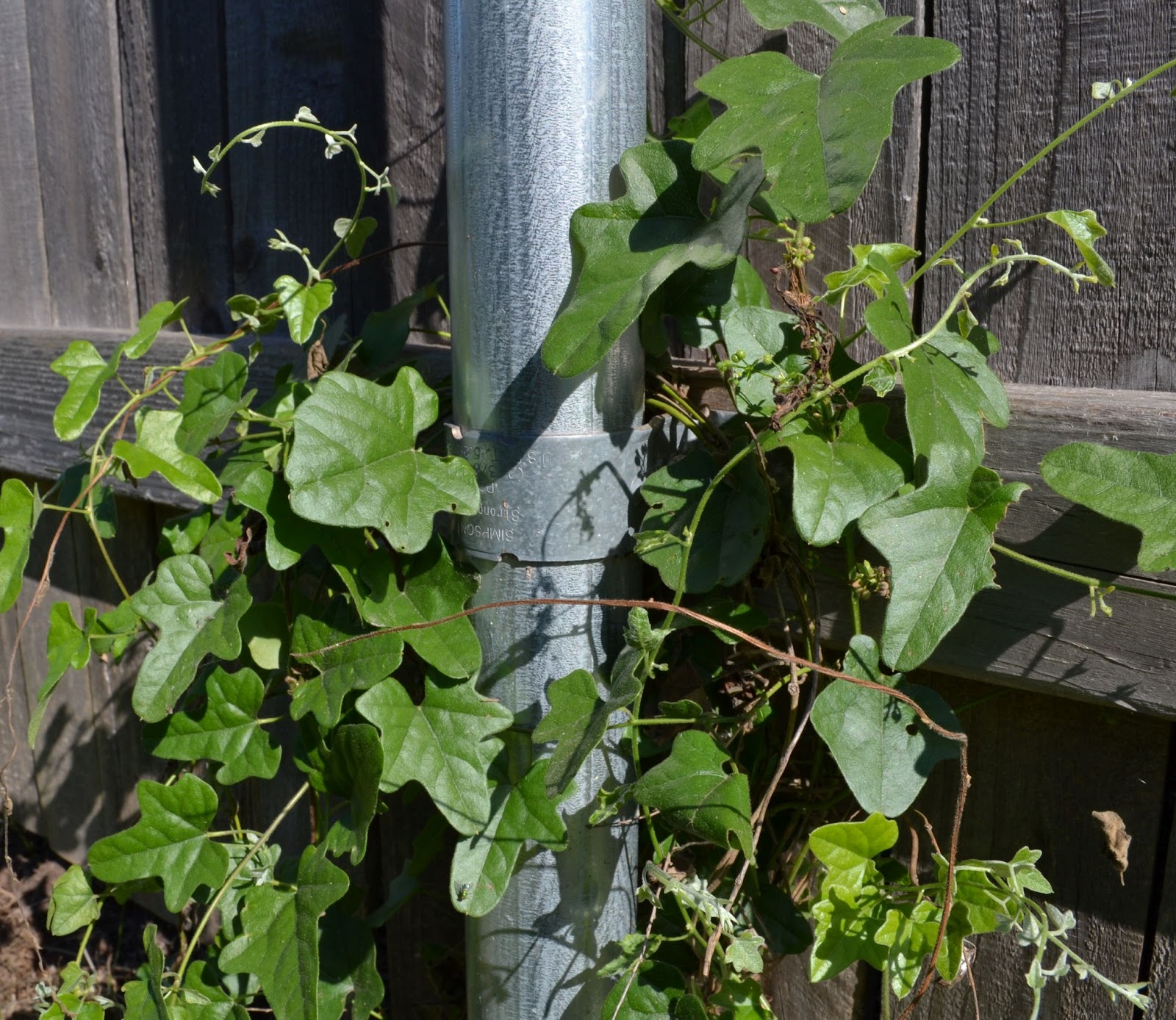
Teresa and her Carolina snailseed vine

My backyard is totally landscaped with natives, grasses, perennials, and trees.  I have recently been overrun by a very NASTY weed/vine that has crept under the fence from an area where I have no access.  I have been using Round-Up and 20% vinegar to NO avail.  Help me eradicate this MONSTER!  Worrying about this weed has made me physically ILL.
Teresa Robinson, Georgetown, TX

 Weeds, like beauty, are in the eye of the beholder.  I submitted a picture of Teresa’s vine to the Texas AgriLife Extension Ask-An-Expert service.  Barron S. Rector, range specialist, identified it as Carolina snailseed, officially known as Cocculus carolinus.  Teresa is driven to all caps by this invasive intruder, which can climb up to twelve feet and cover bushes and small trees, but other gardeners might appreciate snailseed’s propensity to form a dense, drought-tolerant groundcover over poor soil.


Mr. Rector’s diagnosis was confirmed independently by Wayne Rhoden, a Williamson County Master Gardener, who has Carolina snailseed on a trellis in his yard, and likes its fall clusters of red berries which attract birds and squirrels.  The berries are supposedly poisonous to humans, which seems strange if birds can eat them, but I won’t be doing that experiment.


 “When weeding, the best way to make sure you are removing a weed and not a valuable plant is to pull on it.  If it comes out of the ground easily, it is a valuable plant.”  The author of that quote is unknown, but wise in the ways of nature.  Agnes Plutino of the Williamson County Native Plant Society also has Carolina snailseed in her yard and confirmed that it is hard to get rid of once it gets established in a location.  Teresa tried to dig the snailseed out of her beds.  She got down about 12 inches and was still following roots, which of course were tangled up in the roots of her valuable plants.


Mr. Rector, the Ask-an-Expert, prescribed triclopyr, a relatively low toxicity herbicide for woody stemmed plants.  Unfortunately, triclopyr has to be applied to 12 to 18 inches of the vine stem, assuring that the chemical completely encircles the stem so that it absorbs into the root system.  For a vine that pops up everywhere, this could be a tedious process.  It’s probably easier just to change your opinion of what is a weed.
 

Saturday, May 18, 2013

Cloud Juice and Happy Water - Fresh from Dripping Springs

Published in the Sun - May 18, 2013


Richard Heinichen has been a fan of rainwater ever since he and his wife Suzy first moved to Dripping Springs and discovered that the hard, heavily calcified well water made their hair stick out like fright wigs and their blue jeans as stiff as mannequin bottoms.  Rainwater, having been purified by the giant solar still we call the atmosphere, contains essentially no minerals.  Richard installed a rainwater collection system at his home and his neighbors became jealous of his super-soft water.  Soon he was helping people put in their own tanks and gutters.


As more people moved to the Dripping Springs area, wells were getting deeper and deeper, and more and more expensive, and why would anybody dig an expensive well just to shower in stinky, calcified water?  Richard’s hobby developed into a full fledged business building hundreds of rainwater systems, Tank Town World Headquarters.  He would haul jugs of purified rainwater to the job sites for his crew to drink.  One day in 1999 the jugs went dry, but nobody was willing to drink tap water.  They were all spoiled to the clean taste of rainwater.  That’s when the light bulb went on in Richard’s entrepreneurial head:  Bottled rainwater would sell.


His plan was knocked down by the Texas Commission on Environmental Quality (TCEQ).  Rainwater, according to TCEQ, was not an approved source of drinking water.  You could drink water from a well, a lake, a spring, or even a glacier, but getting it straight from the sky was not allowed.  Rain, of course, has been the original source of the water in those other locations for about four and a half billion years.  Richard, described by his wife as pathologically optimistic, is not the kind of person who is easily deterred by a government bureaucracy.  He enrolled in a two year online course to learn all about water infrastructure, sewage, and the biology of water contamination.  When he graduated he was a certified to operate a public water supply.  Like the proverbial squeaky wheel, his persistence prevailed and TCEQ relented.  Then he started in on the Health Department.


After leaping all the hurdles set in his path by TCEQ and the Health Department, Richard built a bottling plant for Cloud Juice.  The building has a 20,000 square foot roof from which he can catch 10,000 gallons of water from a one inch rain.  The gutters divert the rain into tanks (lined with food grade stainless steel) that can hold 250,000 gallons.  The water is filtered by reverse osmosis to .008 microns.  An E. coli bacterium is 60 times bigger than the pores in that filter.  Not even viruses can get through.


As I write these words I am sipping on a chilled bottle of Richard’s Happy Water, the carbonated version of Cloud Juice.  It’s like Perrier, only smoother and gentler.  Currently Richard is selling about 400 cases a week of Happy Water and Cloud Juice, in glass bottles and phthalate free plastic bottles.  He could sell more, but he is already working as hard as he wants.  Although Richard and his wife will deliver to certain high dollar restaurants in the Austin area such as Hudson’s on the Bend or Asti Trattoria, if you want Happy Water or Cloud Juice outside of Austin you are going to have to go to Dripping Springs and get it yourself.  Matthew McConaughey gets special treatment and has five gallon jugs of Cloud Juice shipped to exotic locations wherever he make movies.


Richard shows me a bottle of tap water from an anonymous “weird” city in central Texas.  The bottle has been sitting on his desk for several years.  He shakes the bottle and it becomes a snow globe with all the flakes of minerals that have precipitated out of solution.  Those are the minerals that taste bad and make scum on your shower walls.  Those are also the minerals that rainwater does not contain.  Richard didn’t expect this benefit, but he has had many chemotherapy patients tell him that rainwater is the only water they can drink.  Everything else is just too harsh.  Although he stops short of making health claims for his water, he quotes the adage “The Solution to Pollution is Dilution,” and maintains that his water is the purest and most dilute water you can drink.  Suzy counters that the solution to pollution is no pollution.  Good point, Suzy.


Richard is planning to start brewing beer with his rainwater.  He already has another snappy slogan picked out.  “It’s Not The Best Beer, But It’ll Do.”
 
Richard with a bottle of Happy Water
 

Saturday, May 11, 2013

Sunscreen and stuffer bags

Published in the Sun May 11, 2013


Why do I have to use the special yellow bag to recycle my other plastic bags and cellophane?  Isn’t that wasteful?  Why can’t I just put all my bags inside a plain bag?

It does seem counterintuitive but there is actually a reason.  The bright yellow “Bag the Bag” stuffers are made to stand up to compaction.  They are made of a tough plastic, and there are some little holes at the bottom to let air out so that they deflate when compacted, rather than explode.  A regular bag would come apart when squished and your bags would all fly around and get caught up in the moving parts of the sorting equipment, jamming it up.  The yellow bags are free at the Georgetown Municipal Complex at 300-1 Industrial Avenue, at Garden-Ville at 250 Walden Drive, and at the Sun City Social Center on Texas Drive.  A stuffer lasts at least a month at my house because I really cram them full.

Hey, if you still don’t like the stuffer bags, just don’t recycle plastic films.  It’s OK; the world won’t end if bags and wrappers are low on your priority list.  Repurposing is better than recycling anyway.  Use your plastic bags to line your trash cans or pick up dog poop, and then throw them in the regular trash.  A few plastic wrappers will hardly make a difference.  It’s the big things that matter, like cans, glass, milk jugs, junk mail, newspapers, cardboard, and plastic containers.   If those all go into your single stream recycling bin, you are still an awesome recycle superhero.


Summer is coming.  Does is matter what kind of sunscreen I use?

As with most good questions, this one is complicated.  If you have watched television lately, you have seen a handsome middle aged man applying a medication to his armpit that promises to resolve his manly problems.  Even if you have no interest in that guy’s medical issues, the advertisement demonstrates that stuff you rub on your skin doesn’t just sit there on the outside.  The skin is a doorway to the bloodstream for many chemicals.  The man rubs a little hormone under his arm, and then the fast voice at the end of the commercial advises women and children to stay away from his armpit to avoid exposure to even a tiny bit of leftover medication.  (Most women stay away from men’s armpits even without a warning.)  So now imagine a sunscreen that has multiple active chemicals in it.  You slather that sunscreen all over your toddler’s tender skin, head to toe, and then, if you follow instructions, you repeat the application after a few hours.  One chemical contained in 52% of all American sunscreens, oxybenzone, has hormone-like effects.  Oxybenzone has been detected in the urine of 96% of all Americans, and even penetrates into mothers’ milk.  Retinyl palmitate, a form of vitamin A used in 25% of sunscreens, actually increases skin cancer in mice exposed to sunlight.  Those are just two of the dozens of chemicals used in sunscreens.  (It should be noted that the American Academy of Dermatology maintains that both of these ingredients are harmless as used in sunscreens by humans.)

Sunscreens which physically block radiation with zinc or titanium oxides do not appear to penetrate the skin and are probably safer choices than chemical sunscreens.  Hats are even safer.  The only real side effect with hats is “hat hair,” which in some instances can be quite serious.

Effectiveness is the other big issue with sunscreens.  Many sunscreens protect only against ultraviolet B radiation, the cause of sunburn.  To have even a hope of protection against skin damage, you have to protect against ultraviolet A radiation also.  Even with coverage for both A and B radiation, the Food and Drug Administration does not allow sunscreen makers to claim that their products will protect against cancer or premature aging.  It turns out that the evidence that sunscreens prevent skin cancer is pretty tenuous.  (Now I can expect an angry letter from an indignant dermatologist.)  Sun exposure causes skin cancer, but sunscreen won’t automatically prevent it.  Some researchers claim that sunscreen gives users a false sense of security and they stay out in the sun longer, increasing their risks.

The Environmental Working Group (www.ewg.org) has the gold standard guide to over 1800 brand-name sunscreen products, all rated for safety and effectiveness on a scale of 1 to 10.  The website discusses the different ingredients, and presents more of the research than you will have time to read.  If you spend a lot of time out in the sun, it would be well worth your time to do a bit of reading.  Don’t just buy the cheapest sunscreen in the front of the store.  And do get a nice hat.

Monday, May 6, 2013

Hunting Hogs

Published in the Sun May 4, 2013

Bones Henderson and a feral hog
James “Bones” Henderson is a hired killer, a bounty hunter to be exact.  He has a normal day job at TxDOT, but after hours is when he gets down to serious business.  Bones has agreed let me tag along while he goes hunting for feral hogs.  A rifle equipped with silencer and telescopic sight is racked on the front windshield of his Polaris Ranger.  Between the seats is a box of .308 Winchester cartridges, sniper bullets famous for long range accuracy.  As we barrel through the brush, switchgrass taller than the vehicle whips through the open sides against my shoulder.  While scanning the horizon for his prey, Bones chats congenially about his past, sharing details that most people wouldn’t share with a new acquaintance, especially not one that writes for a newspaper.  He’s got nothing to hide, and he’s happy when he’s hunting.


Feral hogs are the same species as domestic pigs, Sus scrofa.  Both are descended from the Eurasian wild boar brought to the New World by explorers as early as the 1500s.  They are not the same as the native javelinas, found in south Texas.  Feral hogs are a growing agricultural nuisance, causing $52 million worth of damage every year.  They also carry diseases such as brucellosis and tularemia, which can be spread to domestic swine or, rarely, even to humans.


Bones has been hunting feral hogs professionally in Milam and Williamson Counties ever since he left home at age 16, killing or catching an average of 250 to 300 hogs a month.  In a good month he gets over 400 hogs, using any means possible.  He shoots them from helicopters, chases them with dogs, and captures them live in baited traps.  All methods are legal, except poison.  But 22 years of diligent hunting has not decreased the population; there are more hogs now than when he started.  Texas is the epicenter of the hog boom with an estimated 2.6 million head.  Without enough mountain lions and coyotes to keep the numbers down, people are the only significant predator for the hogs.  To keep the population stable would require the removal of 66% of all hogs every year.  Sport hunting is not getting the job done.


Rolling up a hill we spook a family group of several sows and more than a dozen babies, some of them no bigger than puppies.  We jump out of the Ranger and about 30 hogs run panicked in all directions.  The biggest sows outweigh me by 30 or 40 pounds.  Luckily for the hogs, Bones is trying to help us get a good picture and the gun stays in the car.  This group escapes.  Within eight months some of those babies will have litters of their own.  Some sows have two litters a year, averaging five or six piglets per litter.


(It would be ethically inconsistent not to point out that there are ten human beings for every feral hog in Texas, and we are guilty of some significant environmental damage of our own, but that is not the subject of this narrative.)


We spot another group grazing on a nearby hill.  Bones gets out of the Ranger, this time with his rifle.  He walks a little closer, but the hogs see him and take off.  From 175 yards, with the hogs at a dead run, Bones shoots three times and hits three hogs.  I saw this with my own eyes.  The first one was shot through the head.  The second hog dropped, but is not dead.  Normally Bones would finish it off with his knife, but he decides that might be too graphic for a lady journalist.  He shoots it again, and then takes a picture with his phone.  His client will pay him $5.00 for proof of this dead hog, but he just used $4.00 worth of ammunition to kill it.  The third hog, wounded, has disappeared into the tall grass without a confirmatory photograph.  I ask how his client knows that he doesn’t just take several photos of one hog.  Bones says he would never do that; he doesn’t want any bad karma coming back at him.


Back in the Ranger, Bones shows me his custom-made knife with a deer antler handle.  The 12 inch blade was fashioned from the leaf spring of a pickup truck.  The handle and shank have a patina of old hog blood, but the tip is sharp and clean.  For a quick kill Bones shoves it through the armpit right into the heart.


It is far more profitable to catch the hogs alive.  He can sell live hogs to a buyer who will pay $25 for a 100 pound, undamaged hog.  A big boar with tusks is worth $100.  Bones shows us a large circular trap where he caught 22 hogs at one time, but this evening it is empty.  The grass is so lush this spring that the hogs are not tempted by the sour corn bait.


Trapping requires patience.  Bones’s preferred method of capturing live hogs is hunting with dogs.  He outfits his five Catahoula Leopard dogs with Kevlar vests and thick collars that protect their necks from razor sharp tusks.  Also attached to the collars are GPS tracking devices.  When the dogs find a hog they surround it; one dog grabs hold of each ear, while a third goes for a hind leg.  They hold the hog down until Bones arrives and ties the hog up rodeo-style.  Bones has a pen at his house in Thorndale where he keeps hogs for a week after a dog hunt so any wounds can heal up.  He can’t sell them to the buyer until it’s clear that they have survived the dog bites.


The hogs aren’t the only ones who can get bitten.  In February Bones was trying to hog-tie a 300 pound boar.  He lost his grip on the hind leg for a split second, giving the boar just enough time to turn and plunge his 3 inch tusk deep into Bones’s right knee joint, tearing the meniscus.  Even the dogs were stunned, and watched in amazement as the boar inflicted a few more wounds before escaping.


The sixth trap we check finally has a young female in it, about 65 pounds.   She hurls herself at the bars of the cage so fiercely that cuts appear on her snout.  Bones takes a small lasso of rope and dangles it through the top of the cage until her neck and one foreleg are caught.  He pulls her up tight to the wire, still thrashing wildly, hands the rope to my husband Bill and says, “Hold on to this and don’t let go.”  Opening the trap he crawls in to grab the hog’s hind leg.  He drags her out and kneels on her neck.  Still fighting, she lets out a blood-curdling squeal while Bones ties her legs together and puts another loop around her lower jaw.  Bones is 6’5” and this is just a small hog so he picks her up and tosses her in the back of the Ranger, tying her snout to the frame right behind my seat.  She is trembling and breathing very fast.  I touch a bit of her coarse fur, far from the sharp end, and she jumps.    She will get some nice corn in Bones’s pen, but eventually she will end up as bacon in a meat market in Europe or China, where the demand for wild game is high.


Feral hogs make delicious pork, at least the sows do.  The big boars have a gamy scent.  The meat is so lean that Bones says you have to add fat just to make gravy.  He doesn’t eat it anymore, though.  Years of killing them have blunted his appetite for hog meat.  He admits it’s a shame, but the hogs he shoots just lie in the field.  Butchering is too much work and people would rather eat the fat, lazy hogs raised and slaughtered in factory farms.  I am mostly vegetarian, but I would rather eat a hog that had a nice pig life in this beautiful countryside, and then ended up with one really bad day.


I have heard that sport hunters will pay hundreds of dollars for the chance to kill a trophy boar, so I ask Bones if he ever takes those clients.  He says he has, but he really doesn’t like “babysitting,” as he calls it.  He would rather just get his work done efficiently and go home.  He seemed to enjoy giving us a tour of his territory, but acknowledges that if we hadn’t tagged along he would have shot at least 25 more hogs.  It is dark when he drops us off at our car, but Bones gets out and checks the knots on his lone captive.  He can get caught up on his quota tomorrow; there are lots more where she came from.


Sunday, April 28, 2013

Recycling Batteries

Published in the Sun 4-27-2013

Buckets Full of Batteries at Batteries Plus

Batteries create electricity through chemical reactions.  Some of those chemicals would be toxic if released into the environment in an unsafe manner, so what should we do with batteries when they are out of juice?  All batteries can be recycled, but recycling is more important for some kinds of batteries than for others.


A car battery, for instance, contains about 21 pounds of lead.  As long as that lead stays inside the battery, it’s perfectly safe.  But taking the battery apart without precautions can be extremely dangerous.  In 2008 the World Health Organization reported an epidemic of lead poisoning in Dakar, Senegal, in a community that made its living by dismantling car batteries to salvage lead.  Older children would help with the process, and younger ones would play in the dirt where the recycling was taking place, and like babies everywhere, they would eat dirt; dirt that was highly contaminated with lead.  Eighteen children died and dozens more had potentially lethal blood levels of lead, a situation that can cause permanent brain damage.  Unfortunately, this is only one of many examples of people in less developed countries being poisoned by improperly recycled lead-acid batteries.


Luckily in the United States, ninety-eight percent of automotive lead acid batteries are recycled, keeping toxic lead out of the environment.  In fact it’s illegal in Texas to throw your car battery into the landfill.


Remember in 2010 when a lot of children’s jewelry imported from China was found to be heavily contaminated with cadmium?  Cadmium is an essential element in a nickel-cadmium (Ni-Cad) rechargeable battery, where it is sealed up and safe to handle.  But don’t let that cadmium get away because exposure to too much cadmium can cause kidney damage or even cancer.


Button cell batteries, the kind used for hearing aids, cameras, and watches, frequently contain up to 10 milligrams of mercury.  No law prohibits throwing these batteries in the trash, but they should really be recycled to keep mercury out of our landfills.


You can’t put batteries into your single-stream recycling container, so I checked around and found a few good places where you can responsibly dispose of them when they finally burn out.


Matt Gann is the store manager at Batteries Plus, which is located beside the Round Rock Home Depot, just across IH 35 from La Frontera.  Mr. Gann told me that he will accept (for free) car batteries, Ni-Cad batteries, and just about any other kind of batteries anybody wants to bring in, but not lithium ion batteries, which have a tendency to explode.


For $45, Batteries Plus can rebuild a worn out Ni-Cad battery for a cordless power tool so that it is as good as new.  That’s about half the price you would pay for a new DeWalt battery.  Mr. Gann will also take small quantities of alkaline cells, the familiar AA, AAA, and D cells that are so common in our toys and flashlights.  Alkaline cells can be recycled to recover steel and zinc, but there is not much of a market for them, so if you bring in more than a sandwich bag, Batteries Plus will have to charge you a dollar a pound.  Alkaline cells do not contain any toxic materials, so they can actually be thrown in the trash, and you don’t have to feel guilty.


The Hutto Recycling Center, between Hutto and Georgetown on Hwy 1660, will take all kinds of batteries, including lithium ion and alkaline cells, for free.


The Williamson County Recycle Center on county road 156 near Weir will take lithium ion, rechargeable, coin, and car batteries for free as well, but they charge $2 a pound to recycle alkaline cells.


Retailers that sell power tools are required to take back rechargeable batteries that have reached the end of their lives, so at Home Depot there is a big box near the service desk where you can dump your power tool batteries, assuming you don’t want to have them rebuilt at Batteries Plus.  Don’t put alkaline cells in the Home Depot box because they will just get thrown away when the recycle truck comes.


For times of operation and questions about your specific batteries, contact Batteries Plus at 512 600-7800, the Hutto Recycling Center at 512 846-2756, or the Williamson County Recycle Center at 512 869-7287.


Tuesday, April 23, 2013

Debut of Question and Answer Column

Published in the Sun April 21, 2013


The Living Lightly column is venturing into new territory.  If readers will send in their burning questions related to sustainable lifestyle or environmental health, I will try to find the answer.  Then after I publish an answer, if you have a better or different answer that you would like to share with the public, send it my way at bonstump@gmail.com.


Help.  My spare bedroom is full of obsolete computers and monitors.  I have boxes full of keyboards, cables, and mice.  Some of this stuff still works.  Surely somebody could give it a good home.  What can I do with it?


These days we all want the latest techno-gadget.  To check my assumption that there is very little demand for old computers, I headed over to Click Computers on University in Georgetown.  Sometimes it is just too weird how things work out.   Standing next to me at the counter was a very nice man, George Lourigan, who overheard my question.  He immediately spoke up and offered that he takes donated computers and fixes them up for formerly homeless people.  George and a friend, Bob Pearson, run Bridge Ministries, which helps the homeless find permanent living arrangements and get reconnected to society, which of course involves internet access.  George will take computers that are several years old and overwrite the hard drives to remove all personal information.  Now what are the chances that someone who actually wants old computers would be standing at Click’s counter the very moment I walk in to ask my question?  George isn’t sure how many computers he can handle at present, but if you have a good one to donate, contact him at 512 635-3329 or George@georgelourigan.com.


If George doesn’t want it, or if your stuff is in bad shape, you can still reclaim the spare room by taking your old electronics to Goodwill.  They will wipe the hard drive, salvage the good components, rebuild a few functional computers for resale, and recycle the rest.  Goodwill has a deal with Dell Computers called Dell Reconnect.  They will take any brand of computer equipment and recycle it responsibly.  They promise not to export the waste to developing countries for disposal and not to use child or prison labor in the recycling process.


What is the most effective thing I can do to “save the earth?”


On a global scale, the most effective thing we could do as a species is have fewer children.  But for those of us who are already here, the three biggest contributors to our carbon footprints are:  Your diet, your car, and your house.  Meat production, especially cattle, uses huge amounts of both energy and water, so switching to a plant based diet is one of the most important changes you can make, and healthier as well.  Even giving up meat one day a week (Meatless Mondays) is helpful.  Drive a fuel efficient car, or better yet, drive less altogether.  And third, use your air conditioner sparingly.  Wear shorts to sit on the porch and drink iced tea.  (Of course, this idea has more appeal in April than it does in August.)  The impact of changes in the way you eat and live can be huge or small, depending on how enthusiastically you throw yourself into the project.  Notice that recycling is not on the big three list.  Recycling is wonderful, and we should all do it, but the impact on your carbon footprint is not as great as that of diet, transportation, and home energy usage.  It’s just so much easier to focus on recycling because it doesn’t involve those pesky lifestyle changes which are so inconvenient.


Wednesday, April 10, 2013

Rethinking Our Dependency on Cars

Published in the Sun April 10, 2013
Lacey Unger and Cole Cassens

“Couple dies in Easter car crash.”  The headline was stark and the picture heartbreaking.  Cole Cassens sports a broad grin, posing cheek to cheek with his fiancĂ©e.  Lacey Unger looks more like a teenager than a talented 28 year old teacher.  She has always been wispy and delicate.  I have known her since she was 10 years old; her mother Penny Leone is a dear friend.  I saw Penny on Easter morning and she told me how happy she was about the upcoming wedding and what a good man Lacey had found in Cole.


Young people aren’t supposed to die, especially not young people that you know personally.  An extra layer of sorrow is added when a young man and woman looking forward to beginning their married life together are instead united for eternity at a double funeral.  It’s like Romeo and Juliet, except there is no plot to this tragedy, just profound sorrow and helplessness.


Every year in the United States 37,000 people die in traffic accidents and countless others are permanently injured.  As a society we tolerate this carnage because we passionately love our automobiles.  We love the freedom to go wherever and whenever we want, and we want to get there fast.  We all know that driving can be dangerous, but we convince ourselves that we can handle it, that we are better-than-average drivers.  Wear your seat belt, obey the speed limit, don’t drink and drive, don’t talk on the phone (too much), and everything will be fine.  Anonymous people may be killed in accidents but it won’t happen to me.


In truth you take your chances in a diabolic lottery every time you get behind the wheel.  You may be following the rules, but the driver coming towards you could be on the phone, or ill, or drunk, and could suddenly and without warning turn his vehicle into a cruise missile aimed directly at you and there is nothing you can do about it.  Lacey and Cole weren’t drunk.  They were wearing seat belts.  They were driving below the speed limit on a straight road going through a green light when another car unexpectedly turned left, hitting their car and spinning them into a pole.  One minute you are driving home from a happy family gathering and the next minute you are dead.


Lacey’s mom Penny is a nurse and a grief counselor at her church, but nothing prepared her for the overwhelming grief of Lacey’s death.  I know it’s a pipe dream, but maybe we could all pause a moment and rethink our love affair with cars.  Do we have to drive so much, so fast, so aggressively?  Does Texas need to have the highest speed limits in the nation?  Can we provide economical and convenient taxi services for elderly people so they can live independently without driving?  Could trains or buses take some of us to Austin, so we don’t have to fly in tight formation on IH 35?  At the very least can we promise to never, ever text while driving?


We can certainly put a protected left turn arrow on the light at Sun City.


Lacey and Cole were victims of a terrible accident.  Nothing can change that.  But if we decide to stop accepting the sacrifice of so many thousands of lives on the altar of convenient transportation, maybe we could save some other young couple.  Today, while there is still time, hug somebody you love.  And drive carefully.