Saturday, June 29, 2013

Homebuilding Outside the Big Orange Box

Published in the Sun June 29, 2013

Jason Ballard demonstrates a Nest self-programming thermostat

“Smart Building, Better Living,” is the motto of the Treehouse store on South Lamar.  I arrived without an appointment to see Jason Ballard, the force of nature behind this unique home improvement center.  I don’t know what Jason looks like, but this huge store seems like an ambitious business venture, so I inquire of the most distinguished looking man on the floor.  He is not Jason, but goes to look for him.  When he comes back he tells me that Jason is in a meeting but will be with me shortly and invites me to look around.


Wandering past the bulk chicken feed and the home canning supplies, I find myself in flooring.  A big sign lists the pros and cons of various kinds of flooring materials.  Carpet can be made of recycled materials, but harbors dust and allergens.  The wood floors sold here are certified by the Forest Stewardship Council.  Cork is more comfortable on your feet than hardwood and uses waste from the wine industry, so no trees have to be cut down.


The paint department sells wood finishes and paints which are free of volatile organic compounds.  A kitchen design center displays custom countertops made from recycled glass, concrete, sustainable Mexican teak, or even a recycled paper product that feels like any other solid surface countertop.  And this is the really amazing thing, actual salesmen are available to help you plan your new kitchen or bathroom and make sure it’s built and installed correctly.


While I am lusting after countertops, the distinguished looking man tells me that Jason is available, and points to a fresh-faced, skinny lad wearing a blue t-shirt.  What?  That kid looks more like the leader of a church youth group than the president of a multi-million dollar corporation.  Actually Jason is 31 years old and married with children.  He admits, however, that ministry was one of his possible career paths.


Jason grew up hunting and fishing with his grandfather, who taught him respect for the natural world.  They never killed anything they weren’t planning to eat.  After studying ecology at Texas A & M, Jason worked for a while in Colorado with a sustainable building company.  He learned that most buildings are tremendously inefficient and waste vast amounts of energy, but consumers are in the dark about how to improve the situation.   He also realized that no home improvement store would promise its customers, “We will not sell you something that is poison.”  A consumer who wants safe, environmentally responsible products is on his own.  Jason saw a niche in the business world that needed to be filled.


So Jason Ballard, ecologist, decided to go head to head with Home Depot and Lowe’s and create an oasis of non-toxic, sustainable, and energy efficient products.  There was just one tiny little problem:  he knew nothing about running a business.  Well, almost nothing.  He knew that if you take care of people and sell them good things, they will be loyal customers.


He assembled a team of experts to create his brainchild:  lawyers, marketers, merchandisers.  Jason concentrated on vetting his potential products, spending hours on the phone and internet researching ingredients and environmental implications.  Treehouse doesn’t sell anything that Jason hasn’t scrutinized.


I asked Jason to show me something he is really excited about.  Without hesitation he led me to a display of Nest Learning Thermostats.  Everybody knows that programming the thermostat saves electricity, but normal people just never get around to it.  The Nest Thermostat, invented by the same guy who invented the iPod, learns your personal habits and programs itself.  Jason is emphatic, “People always want to put solar panels on the roof.  This $250 thermostat will save more energy than a $10,000 solar system.  Solar panels should be the last thing you do when you are trying to save energy, not the first.”  When the Nest first came onto the market, the makers wanted to sell exclusively to the big box chains.  Every Tuesday for months, Jason called them, begging for the right to carry the Nest, until they finally said, “OK, OK, you can sell it.  Stop calling us.”


Jason used the same hounding technique to get the Switch LED light bulbs.  “This is the Aston Martin of light bulbs,” he brags, “and Treehouse is the first place in the world to sell it.”  The store is phasing out compact fluorescent bulbs, because LEDs save more energy, and don’t contain mercury.


We continue around the store, Jason enthusiastically pointing out a plant-based alternative to WD-40, insulation made from recycled blue jean denim, tankless water heaters.  I ask when he will be expanding into Williamson County.  He admits he would like to open a branch in Round Rock, as soon as he can swing it financially.


On the Treehouse website, Jason has written “Dreams matter:  We believe we all have a say in what tomorrow looks like, so let’s make it even better.”  Hooray for young people like Jason, thinking outside the box.


Wednesday, June 26, 2013

The Horns of a Carbon Dilemma

Published in the Sun June 22, 2013


I read recently that one can be environmentally friendly to the extreme in recycling and energy savings, but that a single short commercial jet flight wipes out anything green you have done over an entire year.  It’s all owing to the fact that jet engines are terribly inefficient and it takes a humongous amount of fossil fuel to keep the plane and its passengers aloft. 

George Flynn, Georgetown
 

George has impaled himself on the horns of a dilemma.  In modern times, we have the luxury of doing things that were completely impossible before the age of fossil fuels.  A few hundred years ago, the only sources of useful power were human muscle, animal muscle, and fire.  The Founding Fathers had large numbers of servants, both voluntary and involuntary, for the express purpose of doing hard physical labor, such as plowing fields and chopping wood.  Today, most of us can’t afford a retinue of servants to do our work for us.  Instead we use fossil fuels, in the form of gasoline or coal-generated electricity.  We have “energy slaves” to cook our food, wash our clothes, light our houses, and push our cars around town.  If you assume that a human worker can sustain a work output of about 80 watts, the average American has 147 “energy slaves” working around the clock to maintain his regal lifestyle, cooling our offices and harvesting our food while we post cat pictures on Facebook.


A Boeing 747 uses about 80 megawatts of power to take off, the equivalent of one million “energy slaves” pedaling like crazy.  You just can’t do that without jet fuel.


On a round trip flight from New York to San Francisco, the combustion of that jet fuel produces 2 to 3 tons of carbon dioxide emissions per passenger.  Since most of us (in the States) generate about 19 tons of carbon dioxide every year, air travel is a significant part of our carbon footprint.  You would be absolutely correct to point out that Al Gore, jetting around the world to discuss climate change, has a much bigger carbon footprint than some unfortunate soul who doesn’t really care about carbon emissions but can’t afford to go anywhere.


So here is the dilemma:  We love to fly.  Who doesn’t adore a vacation in the Caribbean?  We also are hooked on air conditioning, the biggest electricity hog in our Texas homes.  Are we to give up flying and cooling for the sake of being “green”?  There are some who say that if the earth becomes uninhabitable for human beings our grandchildren will wish we had taken this question a bit more seriously, and they have a valid point.  On the other hand, if I personally give up jet travel and air conditioning, staying home to sweat miserably this summer, all my sacrifice accomplishes in the short term is to take the pressure off ERCOT, allowing some less virtuous person to crank his thermostat down to 68 degrees and have friends over to see his pictures from Aruba.


I can’t single-handedly save the planet, but that doesn’t mean I’m off the hook.  I can make a multitude of “green” decisions that actually improve my overall well-being.  Using energy efficient light bulbs saves money on my electric bill.  Eating less meat reduces my carbon footprint and is healthier for my heart.  Locally grown foods are delicious.  A small car is easy to park.  Bicycling tones my bum.  Recycling is completely painless.  Take a train somewhere, or vote to build a train somewhere.


The famous architect and inventor Buckminster Fuller said this about the power of the individual:  “Something hit me very hard once, thinking about what one little man could do.  Think of the Queen Mary – the whole ship goes by and then comes the rudder.  And there’s a tiny thing at the edge of the rudder called a trimtab.  It’s a miniature rudder.  Just moving the little trimtab builds a low pressure that pulls the rudder around.  Takes almost no effort at all.  So I said that the little individual can be a trimtab.  Society thinks it’s going right by you, that it’s left you altogether.  But if you’re doing dynamic things mentally the fact is that you can just put your foot out like that and the whole big ship of state is going to go.”

 
The words “Call Me Trimtab” are engraved on Fuller’s headstone

Sunday, June 16, 2013

Save the Texas "Horny Toad"

Published in the Sun June 15, 2013
Original art by David Stump

When threatened by a predator, the Texas Horned Lizard, widely known as the “Horny Toad,” holds perfectly still in the mistaken belief that its camouflage will protect it.  That strategy might hide it from a hawk, but to a human child a motionless horny toad is all too visible and easy prey.


Most Texas baby boomers, and many generations before us, have fond memories of catching and playing with horny toads.  Deprived of video games, our mothers would send us out into the yard, where we were forced to seek entertainment from the landscape.  Both in town and in the country, horny toads were everywhere, providing hours of diversion.  Genie Vogler remembers tying a string around the little horns on their heads and leading them around on a leash.  Dean Hamilton made his captives pull tiny wagons made out of matchboxes.  Another friend, who wishes to remain anonymous because he is otherwise a kindly soul who deeply regrets his misspent youth, used to blow them up with firecrackers.


I lived on a busy street in Austin, but there were plenty of horny toads around our house, and I frequently kept one in a shoebox.  I probably tried to feed it Velveeta cheese (a personal favorite snack) and of course it wouldn’t eat, so after a few days I would let it go.  I didn’t know that the horny toads in my yard were feasting on the red harvester ants that had a permanent bed on the far side of the driveway.  We never tried to get rid of the ants; they were just part of the territory.  In fact my sisters and I would take bits of food out to the ant bed and watch the ants pick up the crumbs and carry them around.  (It was so much easier to entertain children in those days.)  They were a pacifist group of ants and never tried to bite us, unlike fire ants which are no fun to play with at all.


The harvester ant bed was a flat sandy circle about four feet across with a tunnel in the center.  The ants would go out in search of seeds along trails leading from the bed.  Horny toads would stake out along the trails and eat the ants as they marched by, each horny toad eating 70 to 100 ants a day.  A horny toad has to rotate between several ant beds because the ants wise up and change their trails.


So what happened to all the horny toads?  When I mentioned them to my grown children they looked at me as if I had been riding dinosaurs.  The horned lizard does look prehistoric, but they are not extinct.  They still exist, just not so much in Central Texas.  I contacted Lee Ann Linam, a representative of the Horned Lizard Conservation Society and a wildlife biologist with Texas Parks and Wildlife Department (TPWD), who has been studying horny toads for decades.  She told me that in the last 15 years, she has received only five unconfirmed reports of horny toad sightings in Williamson County, and those might have been Texas spiny lizards instead, which are quite common.  Texas horned lizards have been listed as threatened by the TPWD since 1977.


Habitat loss is a big factor in the decline of horny toads, which prefer native grasslands with bare rocky spots for sunning.  They are not much into shopping malls and suburban developments with St. Augustine lawns.  And as fire ants invaded the area, people became much more hostile to ants in general.  Ant poisons and other insecticides destroyed the harvester ants which are the food supply for the horny toads.  Scientists have tried to teach them to eat fire ants, but they just won’t do it, and who can blame them.


Here’s the action plan for horny toad fans.  If you have a red harvester ant bed on your property, do not destroy it.  Harvester ants are the good guys and compete with fire ants.  Check out the trails around the ant bed in mid morning before it gets too hot.  If you see a horny toad, take a picture and send it to the TPWD.  Don’t use widespread pesticides in your yard.  If you have to destroy fire ants, use boiling soapy water poured directly on the mound, or directly apply a bait containing Spinosad, which is not harmful to the harvester ants. 


Milam County has a population of horny toads, so if we can take care of our harvester ants and keep some of the county natural, just maybe, if we are really lucky, it might be possible for our great grandkids to play with Texas Horned Lizards again.


Saturday, June 8, 2013

Soda Pop and Your Carbon Footprint

Published in the Sun June 8, 2013


In the discussion of climate change, why do you ignore non-fossil fuel sources of carbon dioxide emissions such as the breath of humans and animals, wildfires, campfires, and carbonated drinks?


SG, Georgetown, TX


Let’s look at the carbonated drinks first.  The carbon dioxide (CO2) that makes the satisfying fizz when you pop a top is actually a product of the petrochemical industry, so drinking soda does contribute to your carbon footprint, but just a tiny amount.  A 12 ounce can of soda contains about 2.2 grams of CO2.  You would have to drink 400 gallons of soda to equal the amount of CO2 released from burning one gallon of gasoline in your car.


What about breathing?  Seven billion people exhale a lot of carbon dioxide.  Fortunately, the CO2 that we exhale comes from the breakdown of food that we burn for energy.  And the food that we ate came from plants, which made the carbohydrates from CO2 taken out of the atmosphere.  This recycling of carbon means that the CO2 going into and out of plants and animals has no net effect on the total amount of CO2 in the atmosphere.  Wildfires and campfires are part of the same carbon cycle.  Plant material (wood) is burned in the presence of oxygen and turned into carbon dioxide, but without passing through the inside of an animal.


The carbon dioxide that results from burning oil or coal is a different matter entirely.  The plants and animals that were destined to become fossil fuels were buried underground 300 million years ago.  They had removed carbon from an atmosphere that was higher in carbon dioxide than our atmosphere today.  When we dig up petroleum and coal to power our cars and homes, we release that ancient carbon that was sequestered away so long ago and the total amount of carbon dioxide in the atmosphere increases.


Just as scientists can judge the age of an ancient bone or rock by measuring the decay of radioactive carbon-14 (carbon dating), carbon-14 can tell us whether atmospheric carbon dioxide came from living plants and animals or whether it came from ancient deposits of petroleum or coal.  Ninety-nine percent of the carbon in the world exists as the stable isotope carbon-12.  A few carbon atoms in the atmosphere are hit by cosmic rays from the sun and become radioactive carbon-14.  That means that the carbon breathed in and out by modern plants and animals contains a tiny (one in a trillion) amount of carbon-14.  In contrast, the carbon in fossil fuels has been stored away for millions of years, and the radioactive carbon-14 has had time to completely decay into non-radioactive isotopes.  The CO2 that comes from burning fossil fuels contains no carbon-14.  As the levels of CO2 have risen over the last century, the proportion of carbon-14 has decreased, indicating that the new CO2 in the atmosphere is coming from ancient sources.


Last month the level of CO2 in the atmosphere hit 400 parts per million, a 43% increase since the mid 1850’s.  The last time carbon dioxide levels were this high was 2.5 million years ago, at which time there were no human beings.  It will be quite an interesting experiment to see what happens as CO2 levels continue to rise.

Sunday, June 2, 2013

Keeping the Bees Buzzing in Wilco

Published in the Sun June 1, 2013

Mary Bost and Jimmie Oakley examine a hive
Jimmie Oakley, beekeeper, had an infected bee sting on his thumb yesterday.  Today it is healing, a change which he attributes to the application of bee propolis, also called “bee glue.”  I have never heard of propolis, but Jimmie describes it as “anti-bacterial, anti-fungal, and anti-communist.”  Propolis is a sticky product bees make from tree resins, beeswax, and pollen, and use like caulk to close up small holes in the hive.  If a small creature finds its way into the hive and then dies there, the bees use propolis to permanently entomb the body so they don’t have to live with a stinky carcass.  Jimmie collects propolis from his hives and uses it as a tincture for small injuries or cold sores, a practice which has several thousand years of precedent and some support in the scientific literature.


It turns out that Jimmie’s bee sting was actually self-inflicted.  He has repetitive stress injuries of his thumbs from using his bee smoker, and when the pain flares up he treats it with a bee sting on the thumb joint.  (The bee is conscripted into this treatment reluctantly, because when a bee stings a person, the barbed stinger tears away from the bee’s abdomen, and the bee dies.)  The resulting inflammation is supposed to help the pain in his thumbs, although maybe the sting just hurts so much that it takes one’s mind off the problem.  Jimmie laughs and admits that he might get more relief, with less risk of infection, if he actually rested his thumbs from the smoker for a while.


I must look skeptical about the medicinal properties of bee stings, because Mary Bost, unofficial dowager queen bee of the Williamson County Area Beekeepers Association and Jimmie’s employer, shows me her hands also.  At 91, Mary has some painful osteoarthritis.  Periodically she numbs her hands really well with ice, and lets Jimmie coerce a couple of unlucky bees into stinging her palms.  She affirms this treatment is effective, but I notice she hasn’t done it for about 6 months.


Mary and her late husband, Robert, bought this farm southeast of Georgetown in 1952.  They liked the taste of honey, so they decided to install a beehive.  Knowing nothing about beekeeping, Mary says they made every mistake possible.  Robert ordered one hive of bees from the Sears and Roebuck catalog and they set it up in the yard.  Robert was so excited about his new project that he opened the hive every day to check on his bees.  It turns out that bees prefer privacy, so after a week of Robert’s unwanted intrusions the bees got fed up and left.  Undaunted, Mary and Robert continued to learn about bees and at the peak of their beekeeping career had 150 hives and sold honey to six different HEB grocery stores in the area.  Since Robert died, Mary has slowed down a bit, and now Jimmie does most of the hard work for her.


Jimmie got his start with bees in 1976 when he dropped out of the data processing world and answered a classified ad from a commercial beekeeper in North Dakota.  He and his new business partner would load up thousands of hives on trailers.  They would winter the bees in Texas and let them forage on the flowers in the early spring.   About May, when it started to heat up down here, they would load the bees up again and take them back to North Dakota where spring was just getting underway.  After enjoying the nectar of two springs, Jimmie’s bees could eventually produce over a hundred pounds of honey per hive, twice what they could produce if they hung around in Texas all year.


Jimmie and Mary agree that it was easier to raise bees back in the good old days.  The only bee disease they worried about back then was American foulbrood, a highly infectious, but relatively uncommon, bacteria that could wipe out a hive.  Mary recalls the day the state bee inspector made Robert destroy 15 hives because of foulbrood.  They built a big bonfire and had to burn up all the bees, as well as the boxes and honey frames.  It was the worst day of their beekeeping career.


These days the scourge is Varroa mites, accidently imported into the US in 1987 from Russia or eastern Asia and now affecting all US honeybee hives.  The Varroa mite is a blood-sucking parasite about 1.5 millimeters in size, which is pretty big in relation to a honeybee.  It would be like a person having a tick the size of a softball; not something you would enjoy on your body.  When Varroa mites first arrived in North America they almost wiped out the feral honeybee colonies, the colonies living in trees and not owned by anybody.  Now the wild bees may be developing some resistance, just like the Russian bees who have had to endure Varroa mites for a longer time.  Some beekeepers use mitiicides to control the mites, but it’s hard to kill the mites without also killing the bees, since they are both insects.


The honeybee is not native to America.  It was brought here by European colonists who wanted honey.  As valuable as honey is, the greater economic value of bees is the work they do pollinating our agricultural crops.  Up to one-third of the food we eat relies on bee pollination.  Unfortunately, the bee population is in trouble.  Jimmie says we have half the bees we had twenty or thirty years ago.  That population decline affects our native bumblebees as well, which are also important pollinators.


The cause of the bee decline is not yet completely clear and certainly is multi-factorial.  Widespread use of pesticides may have a role.  Jimmie points out that even if a pesticide doesn’t kill a bee immediately, it could have a long term effect on reproduction or even navigational skills.  If a bee can’t navigate, she can’t find her way back to the hive.


Selective breeding of queen bees for maximum egg-laying ability and honey production has led to a shallow gene pool that may have adverse consequences for long term survival.  Much to my amazement, queen bees can be artificially inseminated!


Other important factors in bee decline are habitat loss and poor nutrition.  Bees like a meadow filled with a variety of flowering plants, blooming one after another all year long.  A monoculture of corn or soy as far as the eye can see is a food desert to a bee.  It blooms once for a week or two, but after that there is nothing for a hungry bee to eat.  Malnutrition is made worse by the harvesting of the bee’s honey, which is their food for the winter and contains nutrients essential for bee health.  Commercial beekeepers often take all the honey and feed the bees instead with high fructose corn syrup.  That would be exactly like us giving up vegetables and whole grains and trying to survive on soda pop.  Mary and Jimmie reassure me that at Bost Farms they always leave enough honey in the hives for the bees to eat.


You can make your yard bee-friendly by planting a variety of native plants that bloom throughout the growing season, providing a source of water, and avoiding insecticides.  If you would like to learn more about beekeeping, contact the Williamson County Area Beekeepers Association at www.wcaba.org.
 

Saturday, May 25, 2013

Driven to Distraction by an Invasive Weed

Published in the Sun May 25, 2013


How much does the electricity cost to drive your Nissan Leaf?
Jim Stuewe, Walburg, TX

 The Leaf can go an average of 40 miles on a dollar of electricity.  That is 4.3 miles per kilowatt-hour at 11 cents a kilowatt-hour.  For comparison, a gasoline car that gets 30 miles per gallon can only drive 9 miles on a dollar of gasoline.  A pickup truck gets about 4.5 miles per dollar.
 

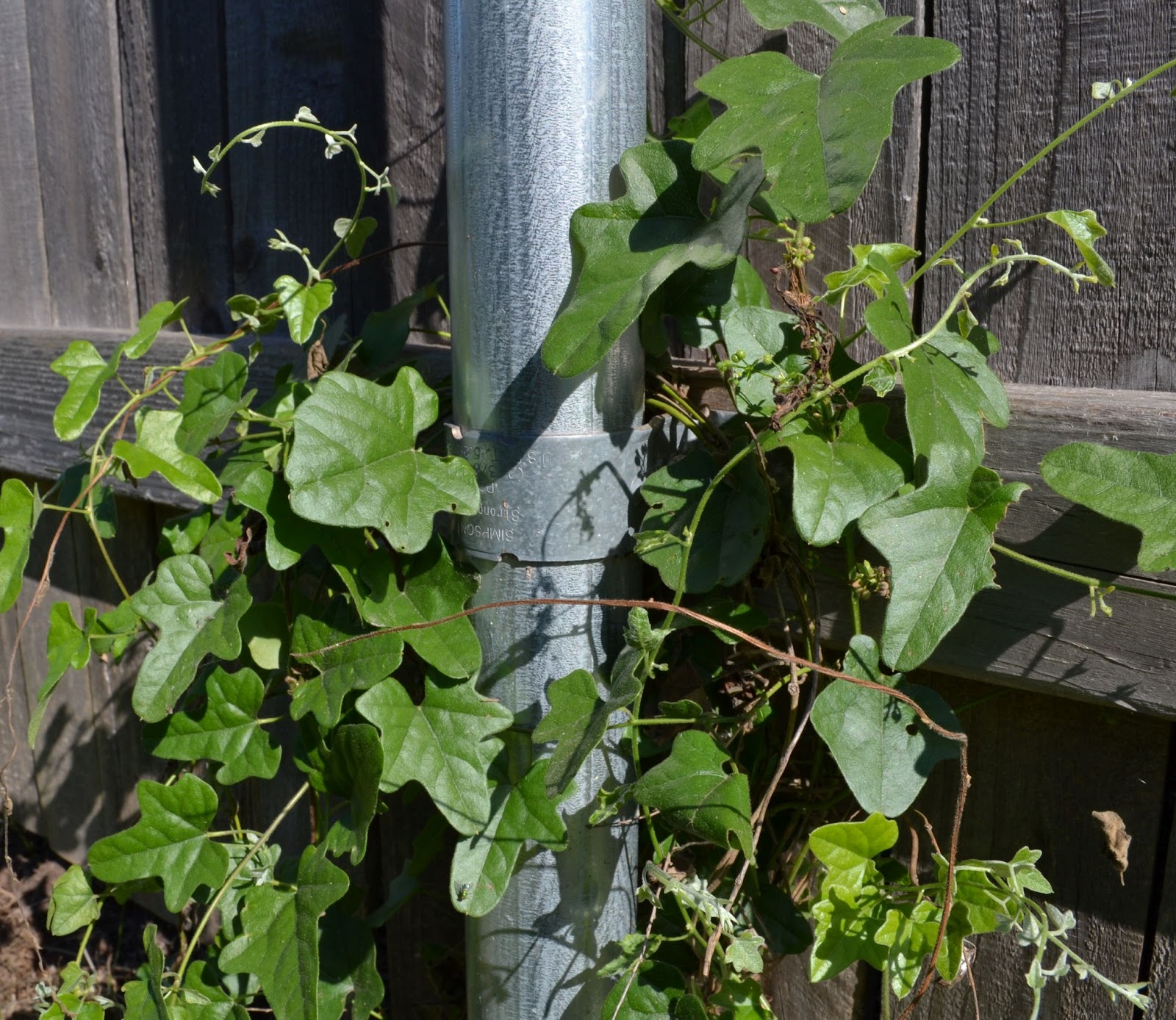
Teresa and her Carolina snailseed vine

My backyard is totally landscaped with natives, grasses, perennials, and trees.  I have recently been overrun by a very NASTY weed/vine that has crept under the fence from an area where I have no access.  I have been using Round-Up and 20% vinegar to NO avail.  Help me eradicate this MONSTER!  Worrying about this weed has made me physically ILL.
Teresa Robinson, Georgetown, TX

 Weeds, like beauty, are in the eye of the beholder.  I submitted a picture of Teresa’s vine to the Texas AgriLife Extension Ask-An-Expert service.  Barron S. Rector, range specialist, identified it as Carolina snailseed, officially known as Cocculus carolinus.  Teresa is driven to all caps by this invasive intruder, which can climb up to twelve feet and cover bushes and small trees, but other gardeners might appreciate snailseed’s propensity to form a dense, drought-tolerant groundcover over poor soil.


Mr. Rector’s diagnosis was confirmed independently by Wayne Rhoden, a Williamson County Master Gardener, who has Carolina snailseed on a trellis in his yard, and likes its fall clusters of red berries which attract birds and squirrels.  The berries are supposedly poisonous to humans, which seems strange if birds can eat them, but I won’t be doing that experiment.


 “When weeding, the best way to make sure you are removing a weed and not a valuable plant is to pull on it.  If it comes out of the ground easily, it is a valuable plant.”  The author of that quote is unknown, but wise in the ways of nature.  Agnes Plutino of the Williamson County Native Plant Society also has Carolina snailseed in her yard and confirmed that it is hard to get rid of once it gets established in a location.  Teresa tried to dig the snailseed out of her beds.  She got down about 12 inches and was still following roots, which of course were tangled up in the roots of her valuable plants.


Mr. Rector, the Ask-an-Expert, prescribed triclopyr, a relatively low toxicity herbicide for woody stemmed plants.  Unfortunately, triclopyr has to be applied to 12 to 18 inches of the vine stem, assuring that the chemical completely encircles the stem so that it absorbs into the root system.  For a vine that pops up everywhere, this could be a tedious process.  It’s probably easier just to change your opinion of what is a weed.
 

Saturday, May 18, 2013

Cloud Juice and Happy Water - Fresh from Dripping Springs

Published in the Sun - May 18, 2013


Richard Heinichen has been a fan of rainwater ever since he and his wife Suzy first moved to Dripping Springs and discovered that the hard, heavily calcified well water made their hair stick out like fright wigs and their blue jeans as stiff as mannequin bottoms.  Rainwater, having been purified by the giant solar still we call the atmosphere, contains essentially no minerals.  Richard installed a rainwater collection system at his home and his neighbors became jealous of his super-soft water.  Soon he was helping people put in their own tanks and gutters.


As more people moved to the Dripping Springs area, wells were getting deeper and deeper, and more and more expensive, and why would anybody dig an expensive well just to shower in stinky, calcified water?  Richard’s hobby developed into a full fledged business building hundreds of rainwater systems, Tank Town World Headquarters.  He would haul jugs of purified rainwater to the job sites for his crew to drink.  One day in 1999 the jugs went dry, but nobody was willing to drink tap water.  They were all spoiled to the clean taste of rainwater.  That’s when the light bulb went on in Richard’s entrepreneurial head:  Bottled rainwater would sell.


His plan was knocked down by the Texas Commission on Environmental Quality (TCEQ).  Rainwater, according to TCEQ, was not an approved source of drinking water.  You could drink water from a well, a lake, a spring, or even a glacier, but getting it straight from the sky was not allowed.  Rain, of course, has been the original source of the water in those other locations for about four and a half billion years.  Richard, described by his wife as pathologically optimistic, is not the kind of person who is easily deterred by a government bureaucracy.  He enrolled in a two year online course to learn all about water infrastructure, sewage, and the biology of water contamination.  When he graduated he was a certified to operate a public water supply.  Like the proverbial squeaky wheel, his persistence prevailed and TCEQ relented.  Then he started in on the Health Department.


After leaping all the hurdles set in his path by TCEQ and the Health Department, Richard built a bottling plant for Cloud Juice.  The building has a 20,000 square foot roof from which he can catch 10,000 gallons of water from a one inch rain.  The gutters divert the rain into tanks (lined with food grade stainless steel) that can hold 250,000 gallons.  The water is filtered by reverse osmosis to .008 microns.  An E. coli bacterium is 60 times bigger than the pores in that filter.  Not even viruses can get through.


As I write these words I am sipping on a chilled bottle of Richard’s Happy Water, the carbonated version of Cloud Juice.  It’s like Perrier, only smoother and gentler.  Currently Richard is selling about 400 cases a week of Happy Water and Cloud Juice, in glass bottles and phthalate free plastic bottles.  He could sell more, but he is already working as hard as he wants.  Although Richard and his wife will deliver to certain high dollar restaurants in the Austin area such as Hudson’s on the Bend or Asti Trattoria, if you want Happy Water or Cloud Juice outside of Austin you are going to have to go to Dripping Springs and get it yourself.  Matthew McConaughey gets special treatment and has five gallon jugs of Cloud Juice shipped to exotic locations wherever he make movies.


Richard shows me a bottle of tap water from an anonymous “weird” city in central Texas.  The bottle has been sitting on his desk for several years.  He shakes the bottle and it becomes a snow globe with all the flakes of minerals that have precipitated out of solution.  Those are the minerals that taste bad and make scum on your shower walls.  Those are also the minerals that rainwater does not contain.  Richard didn’t expect this benefit, but he has had many chemotherapy patients tell him that rainwater is the only water they can drink.  Everything else is just too harsh.  Although he stops short of making health claims for his water, he quotes the adage “The Solution to Pollution is Dilution,” and maintains that his water is the purest and most dilute water you can drink.  Suzy counters that the solution to pollution is no pollution.  Good point, Suzy.


Richard is planning to start brewing beer with his rainwater.  He already has another snappy slogan picked out.  “It’s Not The Best Beer, But It’ll Do.”
 
Richard with a bottle of Happy Water